


Aligning public and private funding to make regenerative farming viable
The resulting report, Partnership by design: How public programs can unlock private co-investment in regenerative agriculture, gives OP2B and its members a quantified evidence base for their dialogue with policymakers and value chain partners. It shows that public and private actors achieve more for farmers when they align their resources than when they work separately.
The strongest result comes from combining outcome-based public payments with a private price premium of €50 per hectare per year. Of the three redesigns tested, this one improves farmers’ business case the most and the most consistently, and for some crops it turns the business case positive. In France, for example, it improves the business case of a dairy farm by €334 per hectare, compared with €22 under blended finance. Because the premium is paid every year, its value holds over the full investment period.
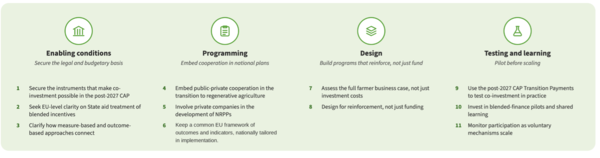
The report turns these findings into eleven recommendations for the European Commission, the European Parliament and Council, Member States, and companies. The recommendations are grouped under four themes: securing the right conditions at the EU level, embedding cooperation in national programming, designing programmes that reinforce rather than only fund, and testing before scaling. They include using the post-2027 CAP and the National and Regional Partnership Plans to introduce outcome-based payments coupled with private support. Outcome-based elements should be phased in monitoring matures, so that farmers do not carry all the risks. The report also proposes the planned Transition Payments as a near-term test bed and calls for EU-level clarity on State aid.
Testing three policy redesigns across five Member States
Schuttelaar & Partners coordinated the project, working with Deloitte, which carried out economic modelling. The study was built on Deloitte’s earlier publication Closing the gap: An analysis of the costs and incentives for regenerative agriculture in Europe, which identified the missing business case for farmers as a key bottleneck.
We began by screening 83 European public programmes. These span the current programming period (2021–2027) and the next one (2028–2034), the latter based on the European Commission’s July 2025 proposal. They include EU, national, and regional initiatives, co-financed by the EU or funded purely from national resources, as well as programmes that already involve public-private partnerships. From these, we selected five programmes in five Member States, covering four types of public support:
-
CAP eco-schemes in Spain,
-
Agri-environment-climate measures in the Netherlands (ANLb) and Germany (AUKM),
-
Investment support under Poland’s CAP Strategic Plan,
-
Outcome-based carbon schemes: France’s Label Bas-Carbone, read alongside the EU Carbon Removals and Carbon Farming (CRCF) Regulation.
We then developed three possible policy redesigns: longer contracts with a committed buyer, outcome-based payments complemented by private price premiums, and blended finance. Each redesign targets a different feature of a programme’s design, so not every redesign fits every programme. For each programme, we therefore focused on the most realistic redesign path. Deloitte then modelled the effect of the relevant redesigns on the business case of arable and dairy farms, and on environmental outcomes at the farm and country level.
To make sure the findings would hold up in practice, we organised validation sessions with national public and private stakeholders. We also engaged stakeholders throughout the project. A Steering Committee of expert organisations was involved in the study: Environmental Defense Fund (EDF), the European Landowners’ Organization (ELO), the Institute for Climate Economics (I4CE), and the Institute for European Environmental Policy (IEEP). Their input strengthened both the analysis and the recommendations.
We then brought everything together in the final report, translating the findings into eleven practical recommendations for EU institutions, Member States, and companies. We were also open about the study’s assumptions, such as its reliance on literature and expert judgement for some dairy inputs, so that readers can interpret the results correctly.


